TL;DR
Yoga teacher Cheryl McColgan recommends tree pose, eagle pose and warrior three as single-leg exercises that can practise balance and stability. She advises beginners to progress from tree to the more challenging poses and use a fixed gaze or support from a wall or chair.
A Fit&Well report identifies tree pose, eagle pose and warrior three as three yoga postures that teacher Cheryl McColgan recommends for practising balance and stability. The poses involve standing on one leg, and McColgan suggests beginners start with tree pose before attempting the more demanding positions.
McColgan, founder of Heal, Nourish, Grow, said yoga can train proprioception: the body’s ability to sense its position and movement. She said poses that require balancing on one leg also work muscular endurance and strength. These are her explanations of why the poses may help; the supplied report does not present a clinical study comparing their effects.
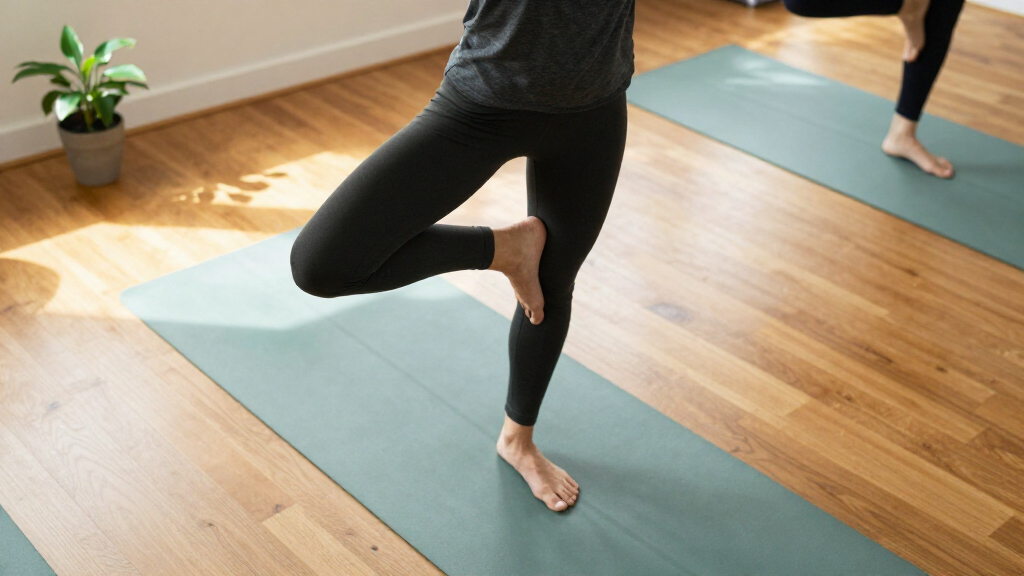
For tree pose, stand with weight on one foot and place the other foot against the standing leg’s ankle, calf or inner thigh. The foot should not press directly against the knee. Hands can be held in prayer position or raised overhead; a wall or chair can provide support. Hold for three to 10 breaths, then change sides.
In eagle pose, bend both knees slightly, cross one thigh over the other and, if possible, hook the crossed foot behind the standing calf. The toes can remain on the floor if that wrap is not comfortable or possible. Cross the arms and bring the palms together if able. Warrior three shifts weight onto one leg as the torso hinges forward and the other leg extends behind. Keep the standing knee slightly bent; hold either posture for three to 10 breaths and repeat on the other side.
How the Poses Practise Balance
The recommendations offer readers a short sequence of single-leg exercises with different levels of challenge. Tree pose allows several foot placements and the option of support, while eagle pose adds a leg and arm wrap. Warrior three asks the practitioner to balance while hinging the torso and extending the free leg, making it a progression rather than the suggested starting point.
McColgan links the poses to the muscles around the ankles, knees and hips, as well as proprioception. Practising those movements may be relevant to people who want to work on steadiness as they age, but the source does not quantify benefits, specify how often to practise or establish that these poses prevent falls. Readers should treat the recommendations as exercise guidance, not a guarantee of an outcome.
Practical adjustments are part of the advice: fix the gaze on one point, and hold a wall or chair if needed. McColgan also suggests a simple alternative for those not ready for the full poses: stand on one leg while brushing your teeth. The report does not provide a formal progression plan or individual assessment.
As an affiliate, we earn on qualifying purchases.
McColgan’s Suggested Progression
The report presents the poses in a sequence based on difficulty: tree pose first, then eagle pose, followed by warrior three. McColgan recommends that beginners work through them in that order. The source does not describe this as a prescribed programme with a set schedule; it is a suggested progression from a more adjustable standing balance to poses with added coordination or a forward hinge.
All three instructions call for holding each side for three to 10 breaths. The report’s central technique cue is to focus the eyes on a single point to help maintain stability. Support from a chair or wall is another option, and the pose descriptions include modifications such as keeping the toes on the ground in eagle pose or bending the standing knee slightly in warrior three.
“One of my favorite things about yoga is that it trains proprioception—your body’s ability to sense its own movements and position—so it can definitely help with balance and stability.”
— Cheryl McColgan, yoga teacher and founder of Heal, Nourish, Grow, as quoted by Fit&Well
As an affiliate, we earn on qualifying purchases.
Evidence and Individual Suitability
The supplied report does not cite a study measuring how much these three poses improve balance, how long any improvement might take, or whether one pose is more effective than another. It also gives no recommended weekly frequency. The stated benefits are McColgan’s guidance, and the source does not establish that the poses prevent falls or injuries.
The report does not assess readers’ health, mobility or experience, so it cannot determine which pose is suitable for every person. It advises using a wall or chair for extra support, but does not offer detailed guidance for people with pain, balance conditions or other limitations. Anyone uncertain about whether an exercise is appropriate for them can seek advice from a qualified health or movement professional.
As an affiliate, we earn on qualifying purchases.
A Supported Start at Home
The source gives no announced follow-up study, class or formal training schedule. Its practical next step is to begin with tree pose, use a fixed gaze and add a wall or chair for support if needed. Readers can try the suggested hold of three to 10 breaths on each side, then move to eagle pose and warrior three only as they feel able.
There is no reported timeline for results. The report’s guidance remains a set of pose instructions from McColgan, rather than evidence of a measured outcome; any assessment of effectiveness would require further information, such as a study tracking participants’ balance over time.
As an affiliate, we earn on qualifying purchases.
Key Questions
Which three yoga poses does the report recommend for balance?
Yoga teacher Cheryl McColgan recommends tree pose, eagle pose and warrior three. Each involves balancing primarily on one leg.
Which pose should a beginner try first?
McColgan suggests starting with tree pose, then progressing to eagle pose and warrior three. Tree pose also allows the foot to rest at the ankle or calf and can be practised with a wall or chair for support.
How long should each pose be held?
The instructions in the report say to hold each pose for three to 10 breaths, then switch sides.
What can help someone stay steady during the poses?
McColgan recommends fixing the eyes on a single point. The report also suggests holding a wall or chair for extra support; in eagle pose, the raised foot’s toes can stay on the floor if needed.
Does the report prove these poses prevent falls?
No. The supplied report offers McColgan’s exercise recommendations but does not provide clinical evidence that these poses prevent falls or quantify their effect on balance.
Source: rss