TL;DR
Fit&Well published a writer’s account of a four-exercise arm workout using one dumbbell and a triceps push-up. The routine is presented as part of three weekly, 30-minute training sessions; the source does not provide independent evidence that it produces results for all users.
Fit&Well has published a writer’s account of a four-exercise arm workout designed for home use, combining one dumbbell with a bodyweight triceps push-up. The writer says the routine fits into a schedule of three 30-minute workouts a week after longer gym sessions became impractical; the article describes a personal approach, not a tested guarantee of results.
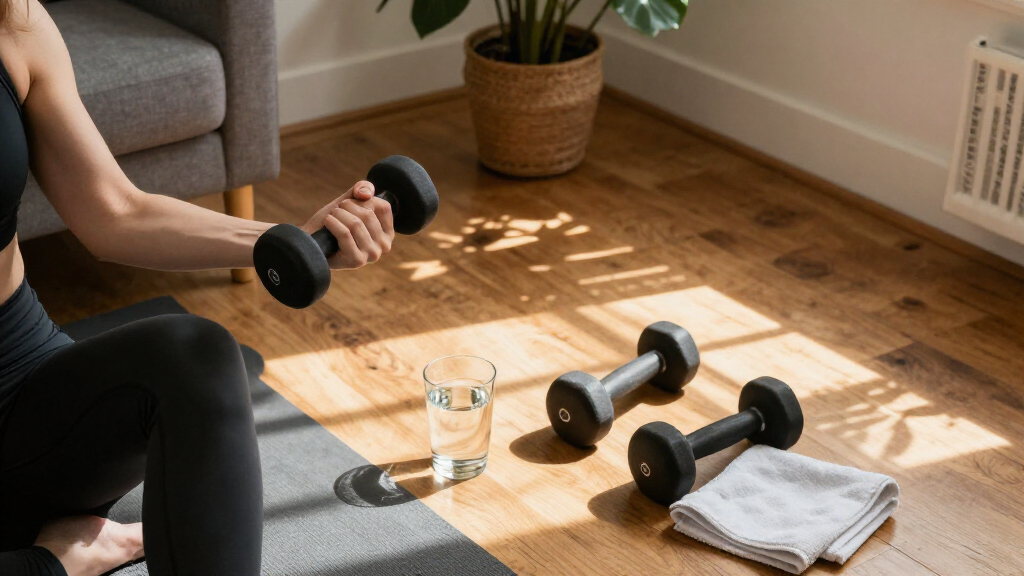
The circuit pairs upper-body movements that work opposing patterns: a half-kneeling single-arm press, a single-arm bent-over row, a single-arm hammer curl and a triceps push-up. The writer recommends doing six to eight repetitions per side for each dumbbell exercise, then as many controlled push-ups as possible. After resting for two minutes, repeat the sequence until completing three rounds.
The article advises choosing a dumbbell that makes the final repetitions challenging. Its progression guidance is to add a small amount of weight once eight repetitions feel easy, and to reduce the load if eight cannot be completed. The writer says they use spinlock dumbbells from Mirafit, sold in the U.K., and notes that CAP Barbell has a similar set in the United States.
For the press, the instructions place one knee on the floor and the opposite foot forward, with the forward knee bent and positioned over the ankle. Holding the dumbbell on the kneeling side, the exerciser presses overhead while keeping the torso controlled. For the row, the exerciser hinges forward, supports one hand on a sturdy surface and draws the dumbbell toward the ribs. The curl keeps the upper arm close to the torso; the push-up is performed from the knees, with hands slightly narrower than shoulder-width.
A Shorter Format for Home Training
The routine’s practical appeal is its compact format: it combines pushing, pulling, biceps and triceps work in one circuit rather than assigning those movements to separate sessions. That may be useful for readers with limited time or access to a gym, although the source does not compare this routine with longer programs or report measured outcomes.
The exercise choices also reflect the writer’s view that arm training can involve more than the muscles named in a workout. Presses and rows recruit the shoulders and upper back alongside arm muscles, while a push-up also challenges the trunk. That makes the session a broader upper-body routine, rather than a set of isolated arm exercises. Individual suitability depends on ability, equipment and health; people with injuries or pain should seek guidance from a qualified professional before changing their exercise routine.
Why the Writer Changed Training
The Fit&Well writer says they previously trained for CrossFit competitions and sometimes spent up to two hours in the gym, five times a week. As life became busier, they shifted to three half-hour sessions, with goals of maintaining strength and mobility. The arm circuit is described as one way to fit upper-body training into that reduced schedule.
The writer also says they are recovering from a lower-back disc injury and prefer the half-kneeling press. They explain that kneeling limits assistance from the legs and may help reduce excessive arching of the lower back. This is the writer’s rationale for choosing the variation, not a clinical recommendation or proof that it is appropriate for every person with a back condition.
“Now I do three 30-minute sessions a week to meet my goal of maintaining mobility and strength.”
— Fit&Well writer
Results and Suitability Are Unverified
The supplied article is a personal account; it does not report a study, measured strength changes, or a comparison with other training plans. The phrase “still get results” in the headline is not backed in the provided material by quantified results, so readers should not treat it as a promise of a particular outcome. The source also does not specify how long the writer has followed this exact circuit or whether the routine is intended for beginners.
It is also unclear whether the three weekly sessions are all identical, how much weight the writer uses, or how the routine changes over time. The article’s back-injury discussion reflects one person’s experience, and does not establish that the kneeling press is safe or suitable for others with back pain or an injury.
How the Routine Could Progress
The article gives a simple progression: use a load that challenges the last repetitions, then increase it slightly when eight reps are easy; reduce it if the target cannot be reached. It does not identify a planned follow-up or provide later results from the writer. Readers considering the circuit can review the exercise instructions, use stable support for rows, and stop if a movement causes pain. Anyone managing an injury can ask a qualified health or exercise professional about appropriate modifications.
Key Questions
What exercises are in the dumbbell arms workout?
The circuit includes a half-kneeling single-arm press, single-arm bent-over row, single-arm hammer curl and a triceps push-up.
How many rounds does the article recommend?
The writer recommends completing three rounds, resting for two minutes between rounds.
How many repetitions should I do?
The article suggests six to eight repetitions on each side for the three dumbbell movements. For the push-up, it says to do as many repetitions as possible. These are the writer’s instructions, not a personalized plan.
Does the article prove the workout gets results?
No. The source is a first-person account and does not include measured outcomes or research comparing this routine with other workouts.
Is the half-kneeling press appropriate for a back injury?
The writer says they prefer it while recovering from a disc injury, but the article does not establish that it is suitable for other people with back problems. Seek guidance from a qualified professional about exercise choices when managing an injury.
Source: fitandwell.com