
TL;DR
Mayo Clinic specialist Kenton Kaufman says balance depends on several body systems that can change with age, and that balance practice may help people improve steadiness. Falls are a leading cause of injury among adults 65 and older, but the report stresses that serious balance problems should be discussed with a health professional before starting exercises.
A Mayo Clinic Q&A published in 2025 addresses why balance can feel less steady with age and describes exercises and professional support that may help. Kenton Kaufman, a Mayo Clinic researcher and specialist, says balance draws on several body systems, and that falls linked to losing balance are a leading cause of injury among adults 65 and older.
Balance is not controlled by a single organ, Kaufman explains. It depends on the coordinated work of muscles, vision, the inner-ear balance organ, nerves, the heart and blood vessels. Changes in these systems can affect steadiness, walking and the ability to remain independent. Kaufman says research from Mayo Clinic’s Motion Analysis Laboratory suggests that the ability to stand on one leg can serve as a measure of how well the nervous system and muscles work together as people age.
The Q&A lists possible warning signs including unsteadiness, falls or feeling at risk of falling, dizziness, lightheadedness, a spinning sensation and changes in vision such as blurriness. It also names potential causes: inner-ear disorders, nerve damage in the legs, vision problems, neurological conditions such as Parkinson’s disease or cervical spondylosis, and side effects of some medications. These are examples, not a diagnosis; the report does not say that any one symptom points to a particular condition.
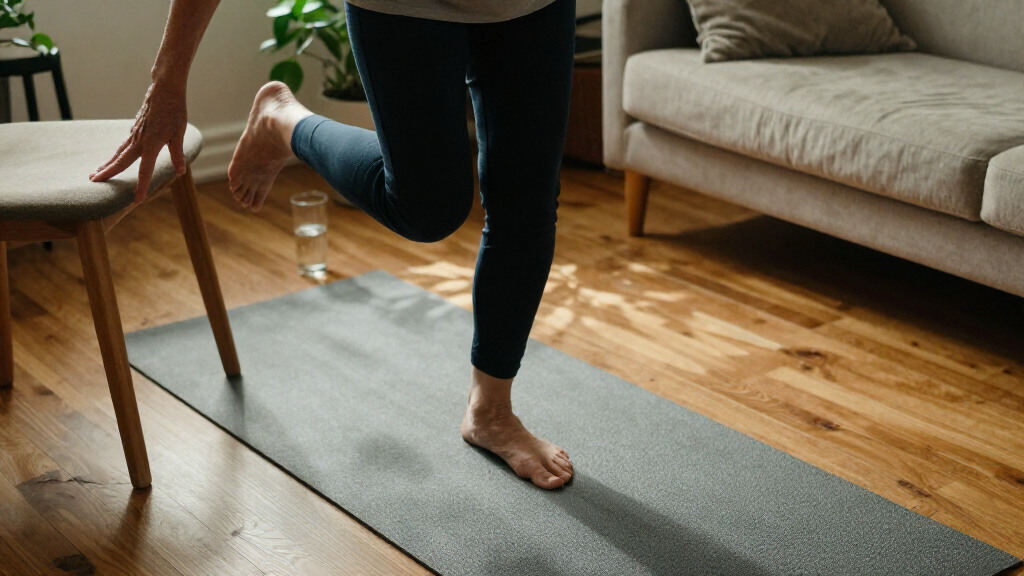
Kaufman recommends several routes for improving balance, including working with a physical therapist trained in balance issues and taking tai chi, yoga or Pilates classes. At home, he describes supported practice such as standing with feet close together, shifting weight from side to side, walking heel to toe and rising from a chair without using the arms. He advises using a stable counter or table for support when needed. People with serious balance problems should check with a health care professional before beginning balance exercises.
Steadiness Can Affect Independence
Balance matters beyond avoiding a stumble: it helps support walking, daily activities and independence. The report says falls are the leading cause of injuries among adults 65 and older and are most often the result of losing balance. That makes changes in steadiness relevant to older adults and to people who help care for them.
The advice is framed as a practical opportunity, not a promise that exercise prevents every fall or reverses aging. Kaufman says balance can improve with practice, while also pointing to medical and medication-related causes that may need assessment. A tailored program from a physical therapist can account for an individual’s abilities and risks. The Q&A does not provide clinical trial results, a fall-reduction estimate or evidence that a specific exercise works for everyone.
balance exercise equipment for seniors
As an affiliate, we earn on qualifying purchases.
As an affiliate, we earn on qualifying purchases.
How Aging Can Affect Balance
The Mayo Clinic item is an educational question-and-answer response to a reader in their early 60s who noticed that their balance felt “off.” It was written by Kenton Kaufman, Ph.D., whose listed Mayo Clinic fields are orthopedic surgery, physiology and bioengineering, at the Rochester, Minnesota, location. The source says the Q&A reflects questions the health care expert has received from patients and is not a substitute for regular medical care.
The report connects balance with muscle strength and gait, meaning the way a person walks. It says clinicians can use changes in these abilities and how quickly they occur to help develop programs for healthy aging. Its one-leg balance timings are presented as general guidance: standing unsupported for 30 seconds is described as good balance, while being unable to do so for five seconds is described as a fall risk. The report does not provide study details or explain how those benchmarks apply across different ages and health conditions.
““The good news is it’s never too late to improve – all it takes is practice.””
— Kenton Kaufman, Ph.D., Mayo Clinic
As an affiliate, we earn on qualifying purchases.
When Symptoms Need Evaluation
The Q&A does not identify the cause of the reader’s balance change or offer a way to distinguish among the possible causes without an evaluation. It also does not establish that the one-leg timings are a diagnostic test, or that meeting a particular time predicts an individual’s likelihood of falling. The listed symptoms can have different explanations, including conditions and medication effects.
Anyone with serious balance problems is advised to consult a health care professional before trying exercises. The source does not specify which individual exercise is appropriate for a given person, how often to practise, or how much improvement to expect. Its suggestions are general educational information rather than a personal assessment or treatment plan.
As an affiliate, we earn on qualifying purchases.
Choose a Safe Starting Point
The next step described in the report depends on a person’s symptoms and current ability. Someone with serious balance problems can speak with a health care professional before practising; a physical therapist trained in balance issues may then design a customized retraining and exercise program. Others may consider a class or supported home practice, using a stable surface for assistance when needed.
The Q&A does not announce a new study, clinical guideline or scheduled follow-up. It leaves the decision about assessment and exercises to the individual and their care team. Its closing reminder is that educational material does not replace regular medical care, particularly when balance changes are persistent, severe or accompanied by other symptoms.
As an affiliate, we earn on qualifying purchases.
Key Questions
Why can balance change as people age?
Kaufman says balance relies on several systems working together, including muscles, vision, the inner ear and nerves, as well as the heart and blood vessels. Changes in those systems can affect steadiness and walking.
What signs of balance problems does the report list?
Examples include unsteadiness, falling or feeling likely to fall, dizziness, lightheadedness, a spinning sensation and blurred vision. The Q&A says these signs can have different possible causes.
Which exercises or activities does Kaufman suggest?
The report mentions physical therapy, tai chi, yoga and Pilates, along with supported home practice such as weight shifts, heel-to-toe walking and standing on one foot. It recommends using a stable object for support when needed.
Should someone with serious balance problems exercise at home?
Kaufman advises people with serious balance problems to check with a health care professional before doing balance exercises. The Q&A does not provide an individualized exercise plan.
Do the one-leg balance timings diagnose fall risk?
No. The report offers 30 seconds and five seconds as general guidance, but it does not describe the timings as a diagnostic test or provide study details showing how they predict risk for each person.
Source: rss