
TL;DR
Doctors removed eight swallowed nails from a woman’s colon using cap-assisted colonoscopy after imaging showed they had stopped near the ileocecal valve. The case report describes minor superficial abrasions and no further complications during one year of follow-up, while warning that the procedure carries perforation risks and requires experienced endoscopists.
Doctors removed eight swallowed nails from a woman’s colon using a cap-assisted colonoscopy after the objects stopped near the ileocecal valve and did not pass during four days of monitoring, according to a case report in BMJ Case Reports. The report says the procedure caused only minor superficial abrasions, and the patient had no further complications during the following year.
The patient, a woman in her 30s with a history of intentionally swallowing foreign objects, came to the hospital with persistent abdominal pain after swallowing multiple nails. It was her sixth episode of foreign-body ingestion in a year, the report’s authors said. Her history included pica and anxiety disorders, and she was receiving psychiatric care.
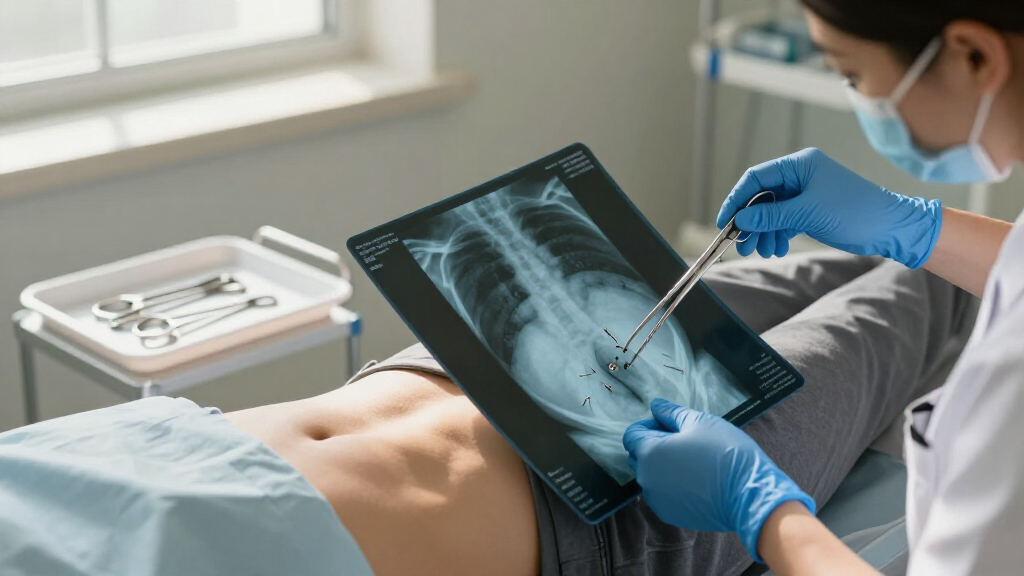
Doctors first monitored her with abdominal X-rays every 12 hours, bowel rest and three liters of polyethylene glycol therapy. The nails moved from the middle of her abdomen to the right lower quadrant and clustered near the ileocecal valve, where the small intestine meets the large intestine. After four days without spontaneous passage, the team proceeded with colonoscopy.
A hard, transparent cap was attached to the end of the colonoscope. The clinicians used a snare to retrieve all eight nails, taking care to keep their sharp ends beneath the cap. An examination after removal found minor superficial abrasions to the colon lining, the authors reported. The psychiatry department recommended admission, but the patient refused. She was followed as an outpatient, and the report says there were no further complications one year later.
How the Cap Helped Protect the Colon
The case describes one way clinicians may approach sharp objects that have reached the colon and are considered too far along for safe removal earlier in the digestive tract. Nails can be difficult to grasp because of their sharp, irregular shapes, and their removal may require surgery. In this case, the cap provided a barrier between the nails and the colon lining as doctors retrieved them.
The authors said the experience supports considering cap-assisted colonoscopy for selected, clinically stable patients without signs of perforation or peritonitis. That is a conclusion from a single case report, not proof that the approach is safe or suitable for every patient. The authors called for surgical backup because perforation can occur before or during the procedure.
As an affiliate, we earn on qualifying purchases.
From Monitoring to Colonoscopy
Many swallowed objects pass through the digestive system without intervention. The report’s authors wrote that about 80% of ingested foreign bodies pass spontaneously. They said endoscopic retrieval may be considered when conservative management does not work or when sharp objects raise concern about perforation.
Foreign-body retrieval is more commonly performed in the upper gastrointestinal tract, according to MedPage Today’s account of the case. Reports of retrieval from the lower tract are limited. A cap is used in other colonoscopy settings to reduce blind spots and help assess lesions; the team used it here to help shield the lining while handling sharp objects.
The patient’s nails were initially thought to have traveled too far for safe endoscopic removal. Repeat imaging, which showed them clustered near the ileocecal valve, informed the team’s decision to attempt retrieval after they remained in place. The report presents this sequence as a case-specific clinical decision.
““It’s pretty rare to have a foreign body that goes all the way down to the lower GI system, and even rarer that sharp foreign bodies go down that far.””
— Bhoowit Lerttiendamrong, MD, of the University of Connecticut School of Medicine, speaking to MedPage Today
foreign object retrieval endoscope
As an affiliate, we earn on qualifying purchases.
As an affiliate, we earn on qualifying purchases.
Limits of the Case Evidence
The report does not establish how often cap-assisted colonoscopy succeeds for sharp objects in the lower digestive tract, or how its risks compare with other approaches. Lerttiendamrong told MedPage Today that the procedure is not widely proven and that there are no specific guidelines for these cases. The authors also noted that advancing a colonoscope with a cap can be challenging in a tortuous or difficult colon, and that the cap itself may cause injury.
The account describes one patient and does not report evidence that the same technique would be appropriate for people with different symptoms, object locations or signs of complications. Whether the patient will have further episodes of intentional ingestion is also not stated.
As an affiliate, we earn on qualifying purchases.
Follow-Up and Clinical Judgment
The patient was being followed as an outpatient, and the report records no further complications one year after the colonoscopy. It does not describe additional treatment or a longer-term care plan. The authors said cap-assisted removal may be useful in selected stable patients when surgical backup is readily available, with the procedure performed by experienced endoscopists.
For clinicians, the case adds to a limited collection of reports on removing foreign objects from the lower gastrointestinal tract. The authors’ account leaves decisions about monitoring, endoscopic retrieval or surgery dependent on the patient’s condition, the objects’ location and the risks seen by the treating team.
As an affiliate, we earn on qualifying purchases.
Key Questions
How many nails did doctors remove?
Doctors removed eight nails with a snare during colonoscopy, according to the case report.
Where were the nails located?
Imaging showed the nails clustered near the ileocecal valve, between the small and large intestines.
Why did doctors use a cap?
The team placed a hard, transparent cap on the colonoscope to help shield the colon lining from the nails’ sharp ends during retrieval.
Was the patient reported to have complications?
The report describes minor superficial abrasions after the procedure and says there were no further complications during one year of follow-up.
Does the case show that this method is safe for everyone?
No. It describes one patient. The authors said the procedure carries a risk of perforation and should be performed by experienced endoscopists with surgical backup available.
Source: rss