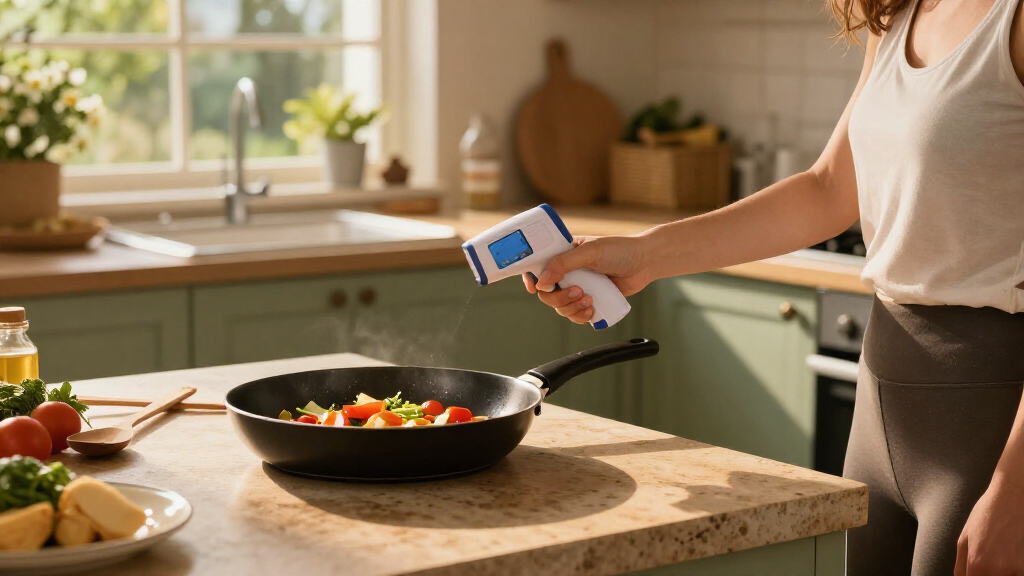
Infrared thermometers for cooking measure surface temperature without touching food, making them useful for checking pans, griddles, pizza stones, and oil. My best overall pick is the TempPro TempScan PLUS TP420, which pairs surface readings with a meat probe for more complete cooking checks. The Ooni Digital Infrared Thermometer is a focused choice for pizza ovens, while the Etekcity Lasergrip 1260 suits shoppers who want a straightforward temperature gun. The main tradeoff is between a simple, quick surface reading and the added cost and bulk of probe-equipped models; laser targeting and temperature range matter, too. Read on for the full breakdown and help matching a thermometer to your cooking style.
Key Takeaways
- Probe-equipped models fill a different role: the TempPro TempScan PLUS TP420 and TempPro TempScan 2-in-1 add a contact probe, so they can check internal food temperature as well as surfaces.
- Pizza cooking favors a focused tool: the Ooni Digital Infrared Thermometer is a specialized fit for checking oven and stone surfaces, rather than a do-everything kitchen thermometer.
- Simple guns suit surface checks: options such as the Klein Tools IR1 and Etekcity Lasergrip models keep the task centered on quick, non-contact readings.
- Temperature range alone does not settle the choice: the Etekcity gun reaches 1130°F, while several alternatives cover lower ranges that may still suit ordinary stovetop and oven tasks.
- Feature overlap makes usability the differentiator: multiple models offer laser targeting and backlit displays, so buyers should focus on probe needs, handling, display readability, and the cooking surfaces they check most.
| TempPro TempScan Infrared Thermometer Gun |  | Best for Adjustable Surface Readings | Temperature range: -58°F to 1022°F | Accuracy: ±1.5% | Emissivity: Adjustable from 0.1 to 1.0 | VIEW LATEST PRICE | See Our Full Breakdown |
| TempPro TempScan PLUS TP420 2-in-1 Infrared Thermometer with Meat Probe |  | Best for Surface and Internal Temperatures | Measurement types: Infrared surface and probe temperature | Infrared distance-to-spot ratio: 12:1 | Infrared upper temperature range: 1022°F | VIEW LATEST PRICE | See Our Full Breakdown |
| Etekcity Infrared Thermometer Laser Temperature Gun, -58°F~1130°F | 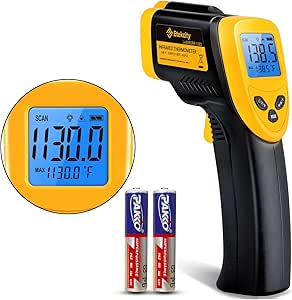 | Best for High-Heat Cooking | Temperature range: -58°F to 1130°F | Distance-to-spot ratio: 12:1 | Emissivity: Adjustable from 0.1 to 1.0 | VIEW LATEST PRICE | See Our Full Breakdown |
| Klein Tools IR1 Infrared Thermometer with Targeting Laser | 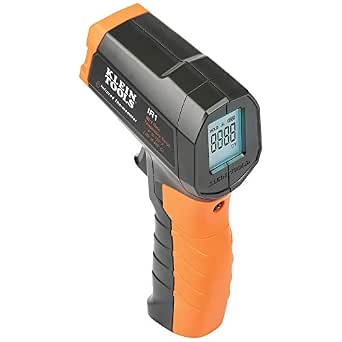 | Best for Straightforward Surface Checks | Temperature range: -4°F to 752°F | Distance-to-spot ratio: 10:1 | Emissivity: Fixed at 0.95 | VIEW LATEST PRICE | See Our Full Breakdown |
| Ooni Digital Infrared Thermometer |  | Best for Ooni Pizza Ovens | Temperature range: Up to 999°F | Temperature accuracy: Within 4°F | Response time: Less than 300 milliseconds | VIEW LATEST PRICE | See Our Full Breakdown |
| Soonkoda GM50 Non-Contact Infrared Thermometer |  | Best for Broad Temperature Range on a Basic Budget | Temperature range: -58°F to 932°F (-50°C to 500°C) | Resolution: 0.1°F or 0.1°C | Display: Backlit LCD | VIEW LATEST PRICE | See Our Full Breakdown |
| OnniFlame Infrared Thermometer Gun for Cooking, -58°F to 1022°F |  | Best for Cooking and Household Versatility | Temperature range: -58°F to 1022°F (-50°C to 550°C) | Response time: 0.5 seconds | Measurement type: Non-contact infrared surface temperature | VIEW LATEST PRICE | See Our Full Breakdown |
| Etekcity Lasergrip 1260 Infrared Thermometer |  | Best for Adjustable Emissivity | Temperature range: -58°F to 1130°F (-50°C to 610°C) | Accuracy: ±2% | Distance-to-spot ratio: 12:1 | VIEW LATEST PRICE | See Our Full Breakdown |
| Etekcity Lasergrip 774 Infrared Thermometer | 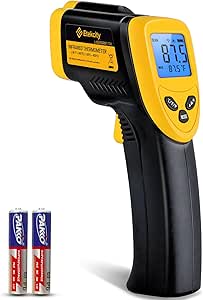 | Best for Everyday Surface Checks | Temperature range: -58°F to 842°F (-50°C to 450°C) | Distance-to-spot ratio: 12:1 | Recommended distance: About 14.17 inches (36 cm) | VIEW LATEST PRICE | See Our Full Breakdown |
| Digital Infrared Thermometer Gun with Backlit LCD |  | Best Compact Pick | Temperature range: -58°F to 712°F | Distance-to-spot ratio: 12:1 | Response time: 500 milliseconds | VIEW LATEST PRICE | See Our Full Breakdown |
| TempPro TempScan 2-in-1 Infrared Thermometer with Meat Probe |  | Best for Surface and Internal Checks | Model: TempScan PLUS TP425 | Measurement type: Infrared surface and thermocouple probe | Infrared temperature range: -58°F to 1022°F | VIEW LATEST PRICE | See Our Full Breakdown |
| TempPro TempScan PLUS TP450 Infrared Thermometer with Dual Laser |  | Best for Aiming at Smaller Cooking Areas | Model: TempScan PLUS TP450 | Temperature range: -58°F to 1022°F | Accuracy: ±1.5% | VIEW LATEST PRICE | See Our Full Breakdown |
| KNINE OUTDOORS Infrared Thermometer Gun, -58°F to 1112°F |  | Best for High-Heat Surface Checks | Model: TG-2024-OG | Temperature range: -58°F to 1112°F (-50°C to 600°C) | Distance-to-spot ratio: 12:1 | VIEW LATEST PRICE | See Our Full Breakdown |
| infrared thermometers for cooking | Temperature range | Display | Response time | Distance-to-spot ratio |
|---|---|---|---|---|
| TempPro TempScan Infrared Ther | -58°F to 1022°F | Backlit digital LCD | 0.5 seconds | 12:1 |
| TempPro TempScan PLUS TP420 2- | — | — | — | — |
| Etekcity Infrared Thermometer | -58°F to 1130°F | Backlit LCD | 0.5 seconds | 12:1 |
| Klein Tools IR1 Infrared Therm | -4°F to 752°F | Backlit digital with auto-hold | 0.5 seconds | 10:1 |
| Ooni Digital Infrared Thermome | Up to 999°F | Backlit full-color digital LCD | Less than 300 milliseconds | — |
| Soonkoda GM50 Non-Contact Infr | -58°F to 932°F (-50°C to 500°C) | Backlit LCD | 10,000 milliseconds | — |
| OnniFlame Infrared Thermometer | -58°F to 1022°F (-50°C to 550°C) | Digital backlit screen | 0.5 seconds | — |
| Etekcity Lasergrip 1260 Infrar | -58°F to 1130°F (-50°C to 610°C) | Color LCD | 0.5 seconds | 12:1 |
| Etekcity Lasergrip 774 Infrare | -58°F to 842°F (-50°C to 450°C) | Backlit digital LCD | 0.5 seconds | 12:1 |
| Digital Infrared Thermometer G | -58°F to 712°F | Backlit digital LCD | 500 milliseconds | 12:1 |
| TempPro TempScan 2-in-1 Infrar | — | — | — | 12:1 |
| TempPro TempScan PLUS TP450 In | -58°F to 1022°F | Digital, dual-color backlit | 0.5 seconds | 16:1 |
| KNINE OUTDOORS Infrared Thermo | -58°F to 1112°F (-50°C to 600°C) | Large digital LCD | — | 12:1 |
More Details on Our Top Picks
TempPro TempScan Infrared Thermometer Gun
The TempPro TempScan is a flexible choice for cooks who want to check griddles, pans, or oven surfaces without touching them. Its adjustable emissivity lets you tune readings to different materials, a useful advantage over the Klein Tools IR1, which uses a fixed emissivity setting. The 12:1 distance-to-spot ratio and half-second response make it easier to take quick readings without reaching over hot cookware. Its range also extends far beyond typical kitchen temperatures, which suits users who want one tool for cooking and household tasks. The tradeoff is that it reads surface temperature only; it cannot tell whether the center of meat is safely cooked. The TempPro TP420 is a better fit if you need a probe as well, while this model keeps the job focused on surface checks.
Pros:- Adjustable emissivity supports readings across different surface materials
- 12:1 distance-to-spot ratio allows readings from a safer distance
- Half-second response and backlit display make quick checks easier
- Maximum, minimum, and average readings help track temperature variation
Cons:- Measures surface temperature rather than food’s internal temperature
- Requires two AAA batteries
Best for: Cooks who regularly check the surface heat of pans, griddles, pizza stones, or grills and want emissivity adjustment for different materials
Not ideal for: People who need internal food-temperature readings, since this model has no probe
- Temperature range:-58°F to 1022°F
- Accuracy:±1.5%
- Emissivity:Adjustable from 0.1 to 1.0
- Distance-to-spot ratio:12:1
- Response time:0.5 seconds
- Readings:Maximum, minimum, and average
- Display:Backlit digital LCD
- Power source:2 AAA batteries
Our verdict“Choose the TempPro TempScan for fast, adjustable surface checks, but pick the TempPro TP420 if you also need a food probe.”
TempPro TempScan PLUS TP420 2-in-1 Infrared Thermometer with Meat Probe
The TempPro TempScan PLUS TP420 earns its place by combining two jobs that a surface-only tool cannot: checking a pan or grill with infrared, then probing food for its internal temperature. Its 2–3 second probe response and stated ±1.8°F probe accuracy make it the most useful option here for cooks who want one device for both tasks. Compared with the TempPro TempScan, it gives up a simpler, dedicated form for broader cooking coverage; compared with the Ooni Digital Infrared Thermometer, it can check the center of food rather than only a baking surface. The infrared side still offers adjustable emissivity and a 12:1 ratio. Its plastic body and battery dependence are practical compromises, and cooks who only monitor pizza stones or pans may not need the added probe.
Pros:- Combines non-contact infrared readings with an internal-temperature probe
- Probe provides readings in 2–3 seconds with stated ±1.8°F accuracy
- Adjustable emissivity and 12:1 ratio support flexible surface checks
- Motion-sensing sleep and wake help manage battery use
Cons:- Plastic construction may feel less durable than a more rugged tool
- Requires two AAA batteries
- The probe adds bulk compared with a surface-only thermometer
Best for: Home cooks who want one thermometer for checking pan or grill surfaces and verifying internal meat or liquid temperatures
Not ideal for: Pizza-oven owners who only need rapid stone readings, or buyers seeking a dedicated compact surface thermometer
- Measurement types:Infrared surface and probe temperature
- Infrared distance-to-spot ratio:12:1
- Infrared upper temperature range:1022°F
- Probe accuracy:±1.8°F
- Probe response time:2–3 seconds
- Infrared response time:0.5 seconds
- Units:°F and °C
- Power source:2 AAA batteries
Our verdict“Pick the TP420 if you need both surface checks and internal food readings in one cooking tool.”
Etekcity Infrared Thermometer Laser Temperature Gun, -58°F~1130°F
For cooks working with very hot pizza ovens, grills, or other high-heat surfaces, the Etekcity Lasergrip 1080 offers the broadest stated upper range in this group: up to 1130°F. That headroom sets it apart from the TempPro TempScan’s 1022°F ceiling and the Ooni model’s 999°F maximum. It also responds in 0.5 seconds, has adjustable emissivity, and displays the maximum surface reading—useful when scanning across a hot cooking area. Its 12:1 distance-to-spot ratio helps keep hands away from heat, though the measurement spot grows with distance, so small targets need careful aiming. Like the TempPro TempScan, it does not measure internal food temperature. The listed information does not provide a stated accuracy figure, so cooks needing a documented accuracy specification may prefer another option with one supplied.
Pros:- 1130°F upper range provides more stated headroom than the other surface-only picks here
- Adjustable emissivity supports different surface materials
- Half-second response and maximum-reading display aid quick heat checks
- 12:1 distance-to-spot ratio supports readings without close contact
Cons:- Measures surface temperature only, not the center of food
- No accuracy figure is stated in the supplied product information
- A 12:1 ratio means the measurement spot can cover more area when used farther away
Best for: Pizza-oven and grill cooks who need a non-contact surface thermometer with extra range for high-heat readings
Not ideal for: Cooks who need internal food temperatures or require a listed accuracy specification before choosing a thermometer
- Temperature range:-58°F to 1130°F
- Distance-to-spot ratio:12:1
- Emissivity:Adjustable from 0.1 to 1.0
- Response time:0.5 seconds
- Repeatability:1% / 1°C
- Measurement increments:0.1°F or 0.1°C
- Display:Backlit LCD
- Power source:2 AAA batteries
Our verdict“Choose the Etekcity Lasergrip 1080 for high-heat surface readings, but select the TempPro TP420 if food’s internal temperature matters too.”
Klein Tools IR1 Infrared Thermometer with Targeting Laser
The Klein Tools IR1 suits cooks who prefer a straightforward tool over the adjustable settings found on the TempPro TempScan and Etekcity Lasergrip 1080. Its fixed 0.95 emissivity removes a setup step, and the laser, backlit display, and auto-hold support simple point-and-read checks on pans, grills, and oven surfaces. The tradeoff is less flexibility: materials with emissivity unlike the fixed setting may produce less suitable readings, while both TempPro and Etekcity let users adjust that value. Its 752°F upper limit also leaves less headroom than those models for very high-temperature pizza ovens. For ordinary cooking surfaces, the compact feature set may be all a buyer needs; for changing materials or intense oven heat, another option in this lineup is better equipped.
Pros:- Fixed emissivity keeps setup simple for routine surface checks
- Laser targeting helps identify the area being measured
- Backlit display and auto-hold make readings easier to view
- Includes a custom pouch and 9V battery
Cons:- Fixed emissivity offers less flexibility than the TempPro TempScan or Etekcity Lasergrip 1080
- 752°F upper limit is lower than the high-heat alternatives in this lineup
- Measures surface temperature only
Best for: Cooks who want a simple laser-targeted thermometer for routine checks on common cookware and grill surfaces
Not ideal for: Pizza-oven cooks measuring very high temperatures or users who need adjustable emissivity for varied materials
- Temperature range:-4°F to 752°F
- Distance-to-spot ratio:10:1
- Emissivity:Fixed at 0.95
- Response time:0.5 seconds
- Targeting:Laser
- Display:Backlit digital with auto-hold
- Power source:1 included 9V battery
- Weight:100 g
Our verdict“Choose the Klein IR1 for uncomplicated checks on common cooking surfaces, but skip it for high-heat ovens or variable materials.”
Ooni Digital Infrared Thermometer
The Ooni Digital Infrared Thermometer is the clearest match for cooks who want to check a pizza stone before launching a pie. It is calibrated for Ooni cordierite baking stones, while adjustable emissivity also allows readings from steel and other surfaces. Unlike the Klein Tools IR1, it reaches up to 999°F and offers spot readings or wider scans with minimum, maximum, and average values. Its sub-300-millisecond response and color backlit display make quick checks easier in changing light. The main limitation is its focus: like the TempPro TempScan, it reads surfaces rather than food interiors, so it cannot replace a probe thermometer. Its 4°F stated accuracy and outdoor-oriented design may be more than a casual indoor cook needs, and the Etekcity Lasergrip 1080 offers a higher stated temperature ceiling.
Pros:- Calibrated for Ooni cordierite baking stones
- Adjustable emissivity supports readings on steel and other materials
- Spot readings and minimum, maximum, and average scan values help assess heat distribution
- Sub-300-millisecond response and backlit color display aid quick checks
Cons:- Measures surface temperature rather than internal food temperature
- The 999°F ceiling is lower than the Etekcity Lasergrip 1080’s stated 1130°F maximum
- Its outdoor-focused design may be unnecessary for cooks who mainly use indoor cookware
Best for: Ooni pizza-oven owners who want to check cordierite stone temperature and compare heat across the cooking surface
Not ideal for: Cooks who need internal food readings, mainly use indoor cookware, or need a thermometer rated above 999°F
- Temperature range:Up to 999°F
- Temperature accuracy:Within 4°F
- Response time:Less than 300 milliseconds
- Resolution:0.1°F or 0.1°C
- Display:Backlit full-color digital LCD
- Readings:Spot, minimum, maximum, and average scan readings
- Power source:2 AAA batteries
- Weight:0.2 kg
Our verdict“Choose the Ooni for checking pizza-stone heat and surface variation, but use a probe thermometer for food interiors.”
Soonkoda GM50 Non-Contact Infrared Thermometer
The Soonkoda GM50 covers surfaces from -58°F to 932°F, giving home cooks room to check chilled items, pans, and hot grill surfaces with one simple tool. Its backlit LCD and hold function make a reading easier to see and keep on screen while you move around the kitchen. Compared with the Etekcity Lasergrip 1260, it has a simpler feature set: the GM50 lists a fixed 0.95 emissivity rather than adjustable emissivity, so it offers less control when measuring different surface materials. Its stated 10-second response time is also much slower than the half-second readings listed for several other options here. Choose it for broad range and basic checks, not speed or material-specific fine-tuning. Like all these infrared models, it measures surfaces, not food’s internal temperature, and polished metal can distort readings.
Pros:- Wide -58°F to 932°F surface-temperature range
- Backlit LCD and hold function help keep readings visible
- 0.1-degree resolution
- Two AAA batteries are included
Cons:- Listed response time of 10 seconds is much slower than the half-second Etekcity models
- Fixed 0.95 emissivity offers less flexibility across surface materials
- Shiny or polished metal can produce inaccurate readings
Best for: Home cooks who want a straightforward, wide-range thermometer for checking pan and grill surface temperatures and do not need rapid readings or adjustable emissivity.
Not ideal for: Cooks who frequently check shiny cookware, need quick repeated readings, or want one thermometer to measure internal food temperature.
- Temperature range:-58°F to 932°F (-50°C to 500°C)
- Resolution:0.1°F or 0.1°C
- Display:Backlit LCD
- Emissivity:0.95 preset
- Response time:10,000 milliseconds
- Power:2 AAA batteries, included
- Length:5.83 inches
- Intended use:Surface temperature measurement; not for human use
Our verdict“Pick the GM50 for basic, broad-range surface checks if speed and adjustable emissivity matter less than a simple display and hold function.”
OnniFlame Infrared Thermometer Gun for Cooking, -58°F to 1022°F
The OnniFlame suits cooks who want one non-contact tool for kitchen surfaces and occasional household checks. Its -58°F to 1022°F range reaches higher than the Soonkoda GM50’s 932°F ceiling, while the stated 0.5-second response gives it a clear speed advantage over the GM50’s listed 10-second response. A large, backlit display and included carrying case add practical value for moving between a grill, griddle, and storage. The tradeoff is that the product specifies a recommended distance of about 14 inches, so buyers should follow the positioning guidance rather than assume close-range readings. Unlike the Etekcity Lasergrip 1260, the supplied specifications do not list adjustable emissivity or an accuracy figure. It is a useful general surface reader, but not a substitute for a probe when checking the center of meat.
Pros:- High maximum reading of 1022°F
- 0.5-second response time and backlit display
- Non-contact design helps check hot or hard-to-reach surfaces
- Includes two AAA batteries and a carrying case
Cons:- Recommended measurement distance is about 14 inches, requiring attention to positioning
- Specifications do not list adjustable emissivity or an accuracy figure
- Not designed for body temperature or internal food temperature
Best for: Cooks who also check grill, griddle, and household surfaces and want quick readings, a carrying case, and a high upper temperature limit.
Not ideal for: Users who need adjustable emissivity, a published accuracy specification, or internal food-temperature readings from a probe.
- Temperature range:-58°F to 1022°F (-50°C to 550°C)
- Response time:0.5 seconds
- Measurement type:Non-contact infrared surface temperature
- Display:Digital backlit screen
- Temperature units:Fahrenheit and Celsius
- Recommended distance:About 14 inches
- Power:2 AAA batteries, included
- Included components:Thermometer, batteries, carrying case
Our verdict“Choose the OnniFlame if you want a fast, wide-range surface thermometer for cooking plus household tasks and can work within its recommended distance.”
Etekcity Lasergrip 1260 Infrared Thermometer
For cooks who measure more than one kind of surface, the Etekcity Lasergrip 1260 offers the strongest control in this group: its adjustable emissivity can be set from 0.1 to 1.0, unlike the fixed 0.95 setting on the Soonkoda GM50. That flexibility can help when surface material affects the reading, though reflective finishes still call for care. The 1260 also combines a 12:1 distance-to-spot ratio, half-second response time, and a range reaching 1130°F, making it better suited than the Etekcity Lasergrip 774 to very hot cooking surfaces. Its color LCD and maximum-temperature display give more visual information than the 774’s backlit LCD. The tradeoffs are a larger feature set to manage and automatic shutoff after 15 seconds. This remains a surface thermometer, not a way to confirm food’s internal temperature.
Pros:- Adjustable emissivity from 0.1 to 1.0
- High maximum temperature of 1130°F
- 12:1 distance-to-spot ratio and 0.5-second response time
- Color LCD shows readings and maximum temperatures
Cons:- Reflective surfaces can still affect readings despite adjustable emissivity
- Automatic shutoff after 15 seconds may interrupt longer checking routines
- More measurement settings may be unnecessary for cooks who only check one type of surface
Best for: Grill and stovetop cooks who measure different surface materials and want adjustable emissivity alongside a high temperature ceiling.
Not ideal for: Buyers who want the simplest possible controls or need a thermometer for internal food temperatures or human readings.
- Temperature range:-58°F to 1130°F (-50°C to 610°C)
- Accuracy:±2%
- Distance-to-spot ratio:12:1
- Emissivity:Adjustable from 0.1 to 1.0
- Response time:0.5 seconds
- Display:Color LCD
- Temperature units:°F and °C
- Power:2 AAA batteries, included
Our verdict“Choose the Lasergrip 1260 when adjustable emissivity and a high heat ceiling matter more than a simpler, less configurable thermometer.”
Etekcity Lasergrip 774 Infrared Thermometer
The Etekcity Lasergrip 774 is a practical middle ground for cooks who want more measurement flexibility than a basic fixed-emissivity model without the 1260’s higher temperature ceiling and color display. Its adjustable emissivity, half-second response, and backlit LCD cover the core needs for checking pans, griddles, and grill surfaces; the maximum-temperature display can also help track a heating surface as it warms. Compared with the Lasergrip 1260, the 774 tops out at 842°F rather than 1130°F, making it a better fit for routine kitchen tasks than especially high-heat applications. It measures the average temperature across the targeted area, not a single tiny point, so a mixed-temperature surface can blur the result. The listed 12:1 distance-to-spot ratio also means distance affects how large an area is sampled.
Pros:- Adjustable emissivity from 0.1 to 1.0
- 0.5-second response with a backlit LCD
- Maximum-temperature display helps follow surface heating
- 12:1 distance-to-spot ratio and Fahrenheit/Celsius selection
Cons:- 842°F maximum is lower than the Lasergrip 1260’s 1130°F ceiling
- Reports an average across the targeted area rather than a single point
- Not intended for body or internal food-temperature measurement
Best for: Home cooks who regularly check cookware or grill surfaces and want adjustable emissivity, a clear backlit screen, and straightforward controls.
Not ideal for: Users measuring very high-temperature surfaces or those who need a pinpoint reading or internal food temperature.
- Temperature range:-58°F to 842°F (-50°C to 450°C)
- Distance-to-spot ratio:12:1
- Recommended distance:About 14.17 inches (36 cm)
- Emissivity:0.1–1.0
- Response time:0.5 seconds
- Repeatability:1% / 1°C
- Display:Backlit digital LCD
- Power:2 AAA batteries, included
Our verdict“Pick the Lasergrip 774 for routine cooking-surface checks if you want adjustable emissivity but do not need the 1260’s higher range.”
Digital Infrared Thermometer Gun with Backlit LCD
At just 4 inches long and 40 g, this thermometer is the lineup’s clearest choice for cooks who want a compact tool that can live in a crowded kitchen drawer or travel with a grill kit. Its 12:1 distance-to-spot ratio, half-second response, and backlit LCD make it capable of checking pans, griddles, and grill surfaces without touching them. The rechargeable power setup also sets it apart from the AAA-powered Etekcity Lasergrip 774, though the supplied specifications do not describe charging time or battery capacity. Its 712°F upper limit is lower than the 774’s 842°F and far below the Lasergrip 1260’s 1130°F, so it is less suited to very high-heat surfaces. As with the other infrared options, reflective surfaces can affect readings, and it cannot check internal food or air temperature.
Pros:- Compact 4-inch length and 40 g weight
- 12:1 distance-to-spot ratio
- 0.5-second response and backlit LCD
- Rechargeable power source
Cons:- 712°F maximum is lower than the Etekcity Lasergrip 774 and 1260
- Reflective surfaces can affect measurement results
- Specifications do not list adjustable emissivity or charging details
Best for: Cooks and grill owners who prioritize a small, lightweight thermometer for routine surface checks and prefer rechargeable power.
Not ideal for: People who regularly measure very hot surfaces, need published emissivity controls, or want readings for internal food or surrounding air.
- Temperature range:-58°F to 712°F
- Distance-to-spot ratio:12:1
- Response time:500 milliseconds
- Display:Backlit digital LCD
- Power:Battery powered; rechargeable
- Weight:40 g
- Length:4 inches
- Measurement type:Non-contact surface temperature
Our verdict“Choose this model for compact, rechargeable surface checks, but pick a higher-range option if your cooking routinely involves extreme heat.”
TempPro TempScan 2-in-1 Infrared Thermometer with Meat Probe
The TempPro TempScan 2-in-1 earns its place for cooks who want to check a pan or oven surface and then verify food’s internal temperature with one tool. Its 12:1 infrared sensor reads surfaces quickly, while the five-inch stainless steel probe measures the inside of meat; that makes it more versatile for cooking than the surface-only TempScan PLUS TP450. The probe’s stated ±0.5°F accuracy is useful for doneness checks, and adjustable emissivity plus MAX/MIN/AVG modes help when comparing different surfaces or tracking temperature swings. The tradeoff is that you’re carrying a probe as well as using a surface sensor, and the probe tops out at 572°F while infrared readings reach 1022°F. Its surface accuracy is also listed at ±3°F, so it is less suited to tight surface-temperature tolerances.
Pros:- Combines non-contact surface readings with internal food temperature checks.
- Probe accuracy is specified at ±0.5°F for doneness measurements.
- Adjustable emissivity and MAX/MIN/AVG modes support varied cooking surfaces and temperature tracking.
- Magnetic back and hanging hole offer flexible storage.
Cons:- The probe’s 572°F upper limit is lower than the infrared sensor’s 1022°F limit.
- Surface accuracy is listed at ±3°F, making it less suited to precise surface tolerances.
- Requires two AAA batteries and adds a probe to store and clean.
Best for: Home cooks who want one device for checking cookware and oven surfaces as well as internal meat temperature.
Not ideal for: Cooks who only need quick, non-contact surface readings or need a probe that handles temperatures above 572°F.
- Model:TempScan PLUS TP425
- Measurement type:Infrared surface and thermocouple probe
- Infrared temperature range:-58°F to 1022°F
- Probe temperature range:-58°F to 572°F
- Probe accuracy:±0.5°F
- Surface temperature accuracy:±3°F
- Distance-to-spot ratio:12:1
- Probe:5-inch 304 stainless steel
- Power:2 AAA batteries, included
Our verdict“Choose this if you want surface checks and internal meat readings in one tool, rather than the simpler surface-only TempScan PLUS TP450.”
TempPro TempScan PLUS TP450 Infrared Thermometer with Dual Laser
The TempPro TempScan PLUS TP450 is a strong fit when you want fast surface readings and a clearer aiming reference than a single-laser thermometer provides. Its dual lasers help frame the target area, while the 16:1 distance-to-spot ratio lets you take readings from farther away than the 12:1 KNINE OUTDOORS TG-2024-OG. That can be handy around a hot oven or grill, though the lasers indicate the measurement area rather than turning the device into an internal food thermometer. The 0.5-second response and MAX/MIN/AVG readings suit quick comparisons across a pan or cooking surface. Adjustable emissivity adds flexibility for different materials. Its main limitation for cooking is the surface-only design: unlike the TempScan TP425, it cannot check a steak’s center. The listed accuracy is ±1.5%, rather than a fixed temperature tolerance.
Pros:- Dual-laser targeting helps frame the area being measured.
- 16:1 distance-to-spot ratio supports readings from farther away than 12:1 models.
- 0.5-second response and MAX/MIN/AVG readings make surface comparisons quick.
- Adjustable emissivity accommodates different surface materials.
Cons:- Measures surface temperature only and cannot replace a meat probe.
- Accuracy is listed as ±1.5%, not as a fixed temperature tolerance.
- Requires two AAA batteries.
Best for: Cooks who frequently scan hot cookware or grill surfaces from a little farther away and value dual-laser aiming.
Not ideal for: Anyone who needs internal food temperatures, or buyers who prefer accuracy stated as a fixed degree tolerance.
- Model:TempScan PLUS TP450
- Temperature range:-58°F to 1022°F
- Accuracy:±1.5%
- Distance-to-spot ratio:16:1
- Response time:0.5 seconds
- Emissivity:Adjustable from 0.1 to 1.0
- Display:Digital, dual-color backlit
- Functions:MAX, MIN, AVG, auto off, low-battery indicator
- Power:2 AAA batteries, included
Our verdict“Pick the TP450 for quick, longer-distance surface scanning with dual-laser guidance, but choose the TempScan TP425 if internal doneness checks matter.”
KNINE OUTDOORS Infrared Thermometer Gun, -58°F to 1112°F
The KNINE OUTDOORS infrared thermometer stands out for its 1112°F upper range, the broadest stated ceiling among these three picks. That extra headroom can suit cooks checking very hot grills or oven surfaces, while also covering occasional pool or HVAC measurements. Its 12:1 distance-to-spot ratio matches the TempScan TP425 but falls short of the TP450’s 16:1 ratio, so the TP450 is the better match for scanning from farther back. Adjustable emissivity and selectable units give this model practical flexibility, and its large LCD is easy to read at a glance. The tradeoff is a straightforward surface-only setup: it cannot check internal doneness like the TempScan TP425. The supplied specifications also do not state an accuracy figure or response time, leaving less information for buyers comparing measurement precision and speed.
Pros:- 1112°F upper range gives it more stated high-temperature headroom than the TempPro picks here.
- Adjustable emissivity and selectable units support different surfaces and temperature scales.
- Large LCD and 0.1-degree resolution make readings straightforward to view.
- Suitable for cooking surface checks as well as pool and HVAC tasks.
Cons:- Surface-only measurement cannot verify internal food temperature.
- 12:1 distance-to-spot ratio offers less reach than the TP450’s 16:1 ratio.
- Provided specifications do not state accuracy or response time.
Best for: Grill and oven users who want a wide surface-temperature range and also plan to check household or workshop surfaces.
Not ideal for: Cooks who need internal food temperatures, longer-distance scanning, or a stated accuracy and response-time specification.
- Model:TG-2024-OG
- Temperature range:-58°F to 1112°F (-50°C to 600°C)
- Distance-to-spot ratio:12:1
- Targeting:Single laser
- Emissivity:Adjustable from 0.1 to 1.0
- Display:Large digital LCD
- Resolution:0.1°F or 0.1°C
- Power:Two AAA batteries
- Length:7 inches
Our verdict“Choose the KNINE OUTDOORS model for high-heat surface checks and broader household use, but choose the TP450 for longer-range aiming or the TP425 for internal readings.”
How We Picked
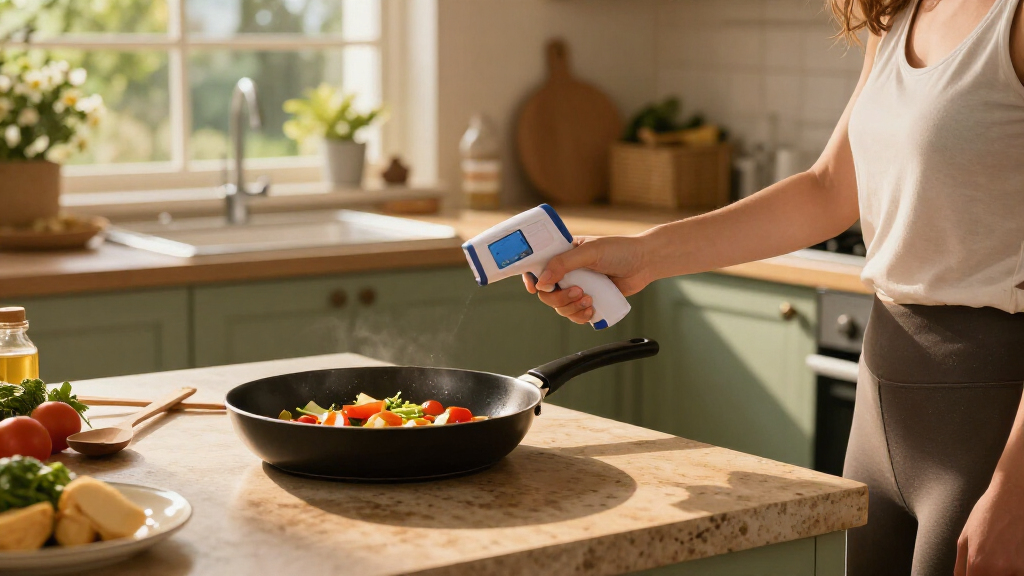
I ranked these infrared thermometers for cooking by how well their design matches real kitchen tasks: checking cookware and cooking surfaces quickly, aiming at the intended area, and reading the result without needless setup. I weighed usable temperature range, targeting features, display legibility, and whether a model adds a contact probe for internal food checks. A broad range is useful for high-heat cooking, but it does not replace a suitable measurement method or make a surface-reading gun a food-safety thermometer.
The order reflects versatility and role clarity, not a claim that every buyer needs the same tool. Probe-equipped TempPro models rank well for cooks who want two measurement methods, while the Ooni stands out for pizza-focused use. Straightforward Etekcity and Klein Tools options make more sense for surface-only checks. Similar-looking models are separated by their stated targeting and display features, range, and the cooking situations they fit; I avoid treating specifications alone as proof of real-world accuracy.
Factors to Consider When Choosing Infrared Thermometers For Cooking
Choosing among these thermometers starts with matching the measurement to the cooking task. The details that matter most are often not the largest number on the box, but what you plan to measure, how precisely you need to aim, and whether you also need an internal temperature reading.
Know Which Surface You Need to Measure
An infrared thermometer reads the surface it is aimed at, not the temperature inside a steak, casserole, or loaf of bread. That makes it useful for checking a pan before adding food, comparing hot and cool areas on a griddle, or checking a pizza stone. A shiny metal pan can reflect surrounding infrared energy and produce a misleading reading, so a dull, matte surface is usually easier to measure consistently. For oil, aim at the liquid surface and avoid treating a reading from the pot wall as the oil temperature. If the task is doneness or food safety, use a probe thermometer instead of relying on a surface reading. Getting the measurement target right matters more than choosing the thermometer with the broadest range.
Match the Temperature Range to Your Cooking
Check the thermometer’s stated range against the temperatures you actually expect to measure, including any high-heat pizza oven or searing setup. A wider maximum can provide headroom for very hot surfaces, as seen in the Etekcity model rated up to 1130°F, but it does not automatically make readings more accurate at everyday cooking temperatures. A lower maximum may be perfectly adequate for pans, griddles, and many home ovens. Compare the lower limit as well if you also plan to check chilled items or cold storage. Do not choose by range alone: the reading method, target size, and surface finish can affect usefulness just as much. A tool suited to your normal routine is often easier to use than one bought for a rarely reached extreme.
Understand Target Size and Laser Aiming
The thermometer measures an area rather than a single point, and that area grows as you move farther from the target. A laser helps show where you are aiming, but it is not a guarantee that the instrument reads only the dot. This distinction matters when checking a small pan, a narrow strip of griddle, or one zone of a pizza stone: a distant reading may blend temperatures from nearby surfaces. Move close enough to keep the measurement area on the intended target, while following the manufacturer’s distance guidance. Dual lasers can help frame the target area, but they do not remove the need to understand the thermometer’s distance-to-spot ratio. For small cooking surfaces, practical aiming control can be more useful than a headline temperature range.
Decide Whether a Probe Is Worth the Extra Tool
A non-contact infrared gun is quick for surface checks, while a probe measures internal temperature through direct contact. A 2-in-1 model can reduce the number of separate devices on the counter, which may appeal to cooks who regularly check both cookware and food doneness. That convenience comes with added parts to store and clean, and the probe still needs careful food-safe handling. If you already own a reliable instant-read probe and mainly want to preheat pans or stones, a simpler infrared-only model avoids paying for overlapping functions. If you do not own a probe, a combination unit may cover more kitchen jobs in one purchase. Choose based on how often you need both kinds of reading, not simply because a model offers more features.
Prioritize Readability and Handling
A temperature reading is only helpful if you can see it while standing at the stove or near a hot oven. A backlit display can help in dim cooking spaces, though it does not compensate for small digits or awkward controls. Consider whether the grip and trigger are comfortable for repeated checks, and whether the device is easy to keep at hand without crowding a drawer. A compact or simple design may suit occasional use better than a feature-heavy model. For regular cooking, accessible controls and a clear screen can save time when you are checking several spots in sequence. Look for the display and controls that fit your kitchen habits rather than assuming every extra feature improves usability.
Treat Care and Calibration as Part of the Purchase
Infrared thermometers do not touch food during surface readings, but their lenses can still collect grease, dust, or steam residue that may interfere with measurements. Follow the maker’s cleaning instructions and avoid wiping the lens with abrasive materials. Check the manual for emissivity settings or calibration guidance, since different surfaces can emit infrared energy differently. A thermometer with limited adjustment may be simpler to operate, while an adjustable model can offer more control for users willing to learn the settings. Store the device away from heat, moisture, and impacts when it is not in use. Routine care and sensible measurement technique matter more than repeatedly comparing readings from different surfaces.
Frequently Asked Questions
Can an infrared thermometer tell me whether meat is safely cooked?
No. These devices read the surface temperature, which can differ greatly from the center of a thick cut or dish. Use a food thermometer with a probe to check internal temperature at the appropriate point. A combination model such as a TempPro 2-in-1 can handle both tasks, but the infrared function still does not replace its probe. For thin foods, avoid assuming that a hot exterior means the inside has reached a safe temperature.
Will an infrared thermometer give a reliable reading from a shiny pan?
Shiny metal can reflect infrared energy from nearby objects, making a surface reading less dependable. A matte or dark surface is generally easier to measure than polished stainless steel or reflective cookware. If you need to check a reflective pan, consult the manual for emissivity guidance and follow its instructions rather than assuming the displayed number is exact. You can also measure a suitable non-reflective area of the cooking surface when available. The thermometer still reports a surface reading, not the temperature throughout the pan.
Is a higher maximum temperature useful for ordinary home cooking?
Usually, not by itself. A higher ceiling is useful if you regularly check very hot pizza stones, ovens, or other high-heat surfaces, but many everyday pan and griddle checks fall well below the maximum ranges listed here. The Etekcity model rated to 1130°F offers extra headroom, while other models may still cover routine kitchen work. Also compare the minimum range, aiming behavior, and ease of reading. Range should match your cooking habits rather than serve as a stand-in for accuracy.
Should I choose a model with a meat probe or buy a separate probe thermometer?
A built-in probe makes sense if you want one device for quick surface checks and occasional internal readings. It can be a practical fit for a kitchen where storage space is limited or where both tasks happen in the same cooking session. A dedicated probe thermometer may be preferable if you check internal doneness often and want a tool designed around that job. Either way, keep probe cleaning and food-safety handling separate from non-contact surface checks. The right choice depends on whether the combination feature will get regular use.
How close should I hold an infrared thermometer to a pan or pizza stone?
Follow the manufacturer’s stated distance-to-spot guidance, because the measured area expands as the thermometer moves farther from the target. The laser indicates aiming direction, but the reading can include a wider patch than the dot suggests. For small pans or individual hot spots on a stone, move closer while keeping a safe distance from heat and following the device instructions. Take readings from more than one location if the surface may heat unevenly. Consistent distance makes comparisons between spots more useful.
Conclusion
For the broadest kitchen role, I would choose the TempPro TempScan PLUS TP420 as the best overall pick because it combines infrared surface checks with a meat probe. The best value depends on your needs: a straightforward Etekcity Lasergrip model makes more sense for basic surface readings, while a combination TempPro is the stronger choice if you also need a probe. For pizza-focused cooks, the Ooni Digital Infrared Thermometer is the specific-use recommendation; for beginners who want simple surface checks, I would start with the Klein Tools IR1 or an Etekcity Lasergrip. The best premium-style choice among these is the TempPro TempScan PLUS TP450 for buyers drawn to dual-laser targeting, though that feature is most useful when aiming matters to their setup. Match the tool to the measurement: surface-only cooking calls for a simple infrared gun, while doneness checks call for a probe.